
The head spa equipment market has developed significantly in just a few years. What was once a niche reserved for a few pioneering salons has become a sought-after service for an increasingly wide professional clientele: hairdressers, beauticians, wellness centers, and hotel spas. Faced with this demand, Japanese head spa equipment has been categorized into several types, each meeting different constraints of space, budget, and commercial positioning.
Choosing the right Japanese head spa machine is not just about comparing technical specifications. It is above all a strategic decision: what protocol do you want to offer? What is the configuration of your space? Does your premises have a water supply? Can you invest in a fixed installation now, or do you prefer a modular solution?
This guide helps you answer these questions in order, to choose the most suitable equipment for your situation — not the best-selling or most promoted.
Understanding the main categories of head spa equipment
Before delving into the selection criteria, it's helpful to distinguish the three main categories of machines available on the professional market.
The non-plumbed head spa basin
This is the entry-level solution. An ergonomic basin – designed to accommodate a client's neck and shoulders in a reclining position – is manually filled and emptied. No plumbing work is required. This is the preferred option for professionals who want to test the head spa without technical commitment, or who operate in a space where the configuration does not allow for water supply modifications.
The main advantage of this type of equipment is its flexibility: it can be installed in almost any room, moved if necessary, and its acquisition cost is lower than plumbed solutions. However, the protocol is more manual, and water management between each client requires rigorous organization.
The plumbed basin
Same ergonomic architecture, but with integrated water supply and drainage. The practitioner has a continuous flow, which significantly streamlines the protocol and improves working comfort during busy days. This type of professional head spa basin is ideal for salons that perform several sessions a day and want durable equipment without upgrading to a full table.
The integrated head spa table
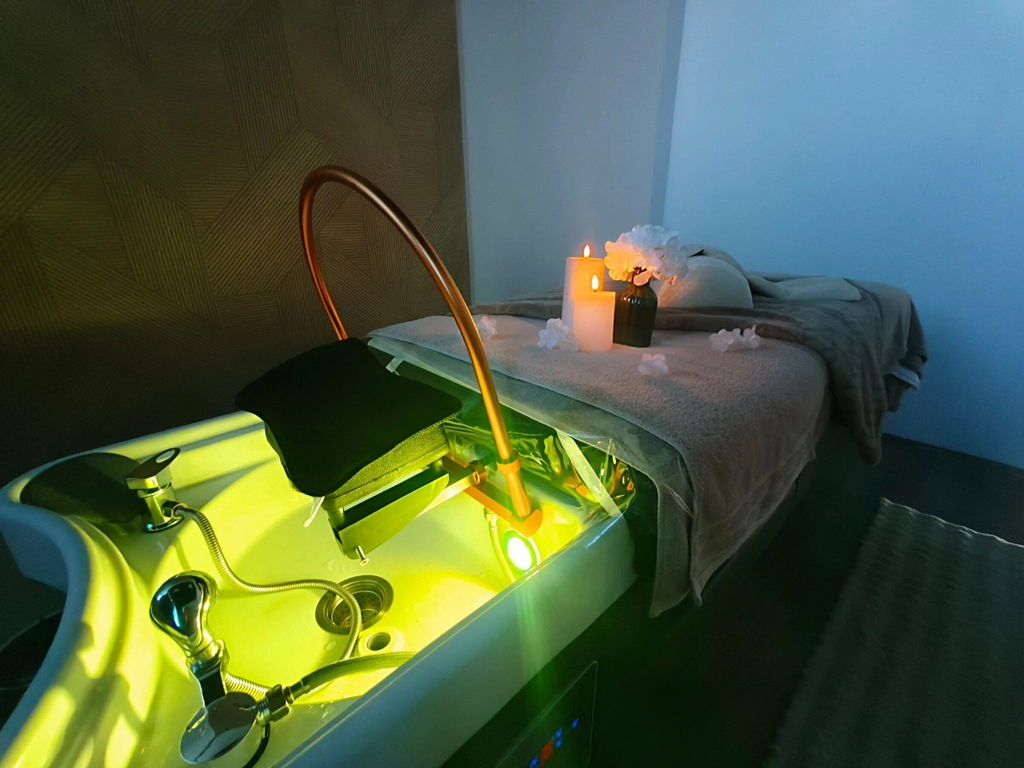
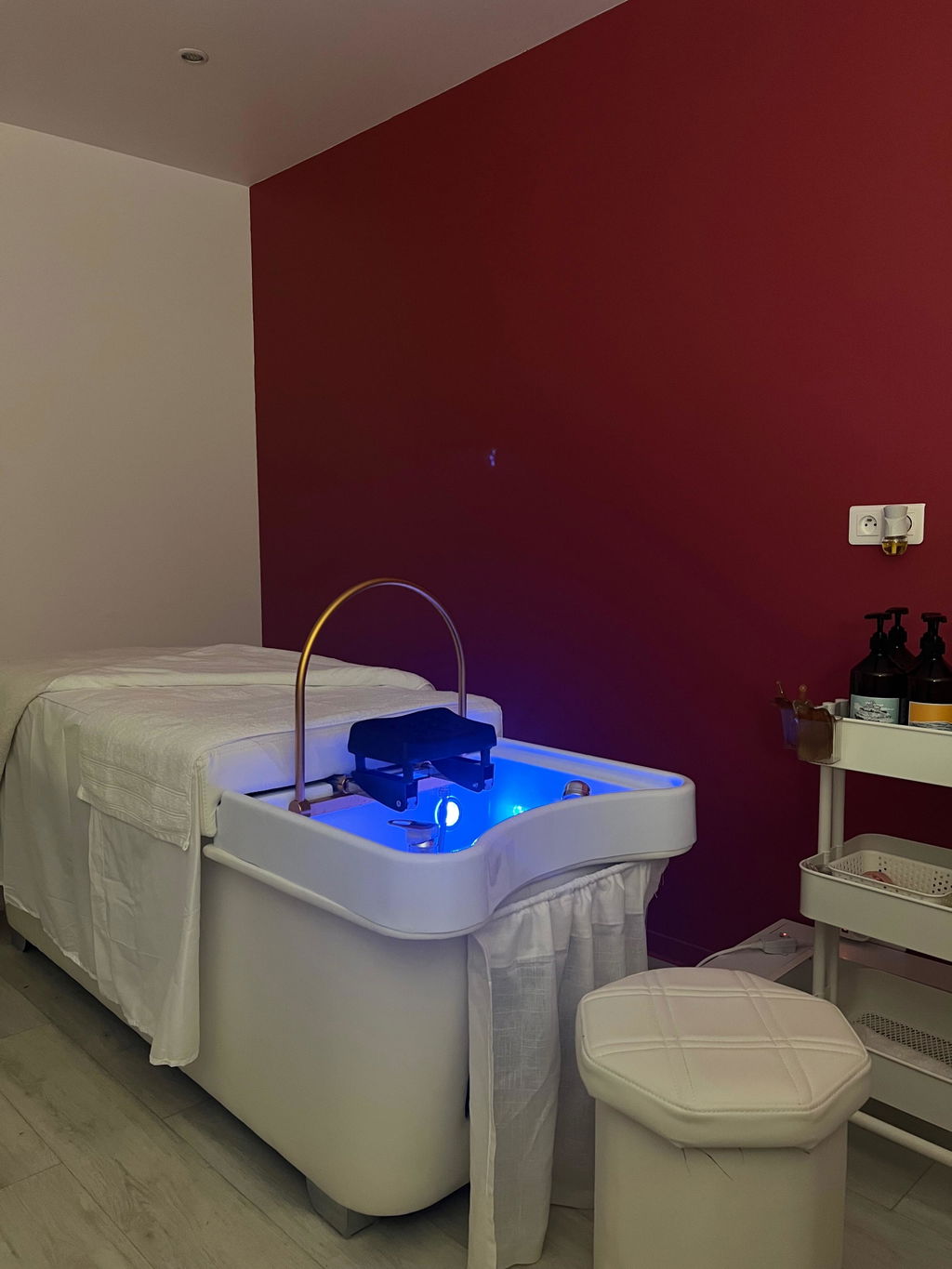
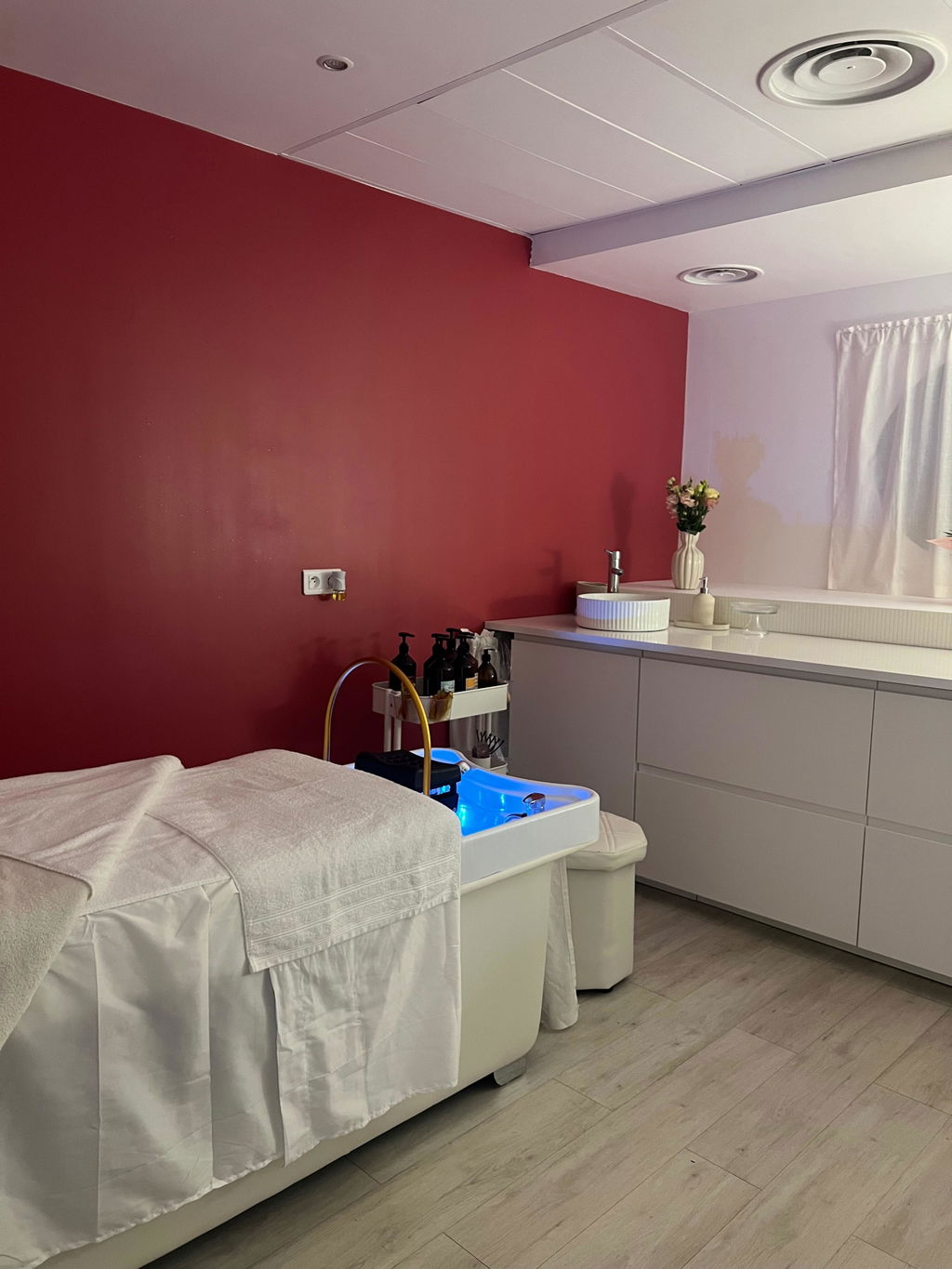
This is the most comprehensive and committing solution. A Japanese head spa table integrates into a single piece of furniture the work surface, washing basin, sometimes a jet massage system, and in some models, complementary aesthetic functions (leg rest, adjustable armrests, electric recline system). It requires a fixed connection and a dedicated surface, but it transforms the service into a clearly identifiable premium experience.
With this overview, here are the concrete criteria on which to base your decision.
Criterion 1: The configuration of your space
This is the first filter, and often the most restrictive. A Japanese head spa machine is not a compact tool: it requires space for the reclining client, for the practitioner moving around the station, and for passage between areas.
As a general rule, allow a minimum of 6 to 8 m² dedicated for a basin station, and 8 to 12 m² for a complete table — taking into account the necessary circulation for working in good ergonomic conditions. If your surface is constrained, a non-plumbed basin that can be positioned in an accessible corner is preferable to an undersized table in an unsuitable space. The Izumi model, for example, is designed precisely for this type of configuration: compact, non-plumbed, it integrates into an existing space without requiring structural reorganization.
The plumbing connection is also a decisive factor. If your premises already have a water supply and drainage near the intended area, a plumbed solution represents only a small additional installation cost. If not, the cost of plumbing work must be included in your total equipment budget from the outset.
Criterion 2: The projected volume of sessions
A practitioner who offers head spa as a complementary service, two to three times a week, does not have the same needs as a salon that makes it its main service with a full schedule from Monday to Saturday.
For intensive use — more than five to six sessions per day — a plumbed solution with continuous flow is strongly recommended. Manual water management on a non-plumbed basin quickly becomes time-consuming and physically demanding at this pace. Conversely, for occasional activity or during the start-up phase, investing in a complete installation before validating customer demand is an unnecessary financial risk.
The right approach is often progressive: start with non-plumbed equipment to validate customer interest, then evolve to a more permanent solution once the appointment book is stable.
Criterion 3: The pricing positioning of your service
The type of machine you install directly influences the perceived value of your service — and therefore the price you can charge.
A mobile basin in a multi-purpose room sends a different signal than a dedicated table in a space designed for the client experience. This is not a value judgment on the equipment itself — a well-mastered protocol on a non-plumbed basin can be excellent — but the consistency between the equipment, the setting, and the price is a factor that your clients evaluate, often unconsciously.
If you are aiming for a premium positioning — above €80 to €100 per session — an integrated head spa table, in a dedicated space with a polished visual identity, is almost essential. The Kyoto and Sapporo models in the Sakura range fit this profile: plumbed tables with refined finishes, designed for salons that make head spa their signature service. If you position head spa as an introductory service or an accessible complementary treatment, a quality basin is more than sufficient.
Criterion 4: Truly useful technical functions
The Japanese head spa machine market offers a wide range of functionalities: pulsating jets, ultrasonics, infrared, filtration systems, temperature control, etc. Not all of them are equally relevant depending on your practice.
Here are the functions that provide real value in a professional context:
- Water temperature control is fundamental. Precise control between 36 and 40 °C significantly improves client comfort and treatment quality.
- The integrated drainage system on plumbed tables reduces protocol interruptions and improves working ergonomics.
- Electric height adjustment, available on some high-end tables, is a significant comfort for practitioners who perform several sessions a day.
- The quality of the neck rest directly affects client comfort throughout the treatment. This is a detail that makes a real difference in client loyalty.
Conversely, some functions sold as differentiating — automated massage jets, integrated LEDs — have little impact on the treatment outcome if the manual protocol is not mastered. Do not let them disproportionately weigh on your purchasing decision.
Criterion 5: Consistency with your overall offering
A head spa machine is not evaluated in isolation. It integrates into an offering, a space, a customer journey. Before choosing a model, ask yourself the following questions:
- Do you want to offer only head spa, or combine it with other treatments (facial aesthetics, pedicure, body treatments)? In this case, a multifunctional table can offer better profitability per square meter.
- Is your current clientele ready to adopt this service, or do you first need to raise awareness? If you are just starting out, the visibility of the equipment in your salon can play an educational role.
- What is your investment horizon? If you plan to expand your business within 18 to 24 months, anticipating an evolving equipment now may be more economical than changing machines mid-way.
Common mistakes in choosing a head spa machine
After assisting several hundred salons, institutes, and spas in setting up their head spa equipment, we observe that certain mistakes regularly recur — and they are almost always avoidable.
Underestimating the importance of installation. Buying equipment without anticipating installation constraints — plumbing, space, electricity — often generates unexpected delays and costs. Take the time to evaluate your premises before ordering.
Overestimating your feature needs. A machine well-chosen for your level of practice is more efficient than oversized equipment of which you will only use 30% of the functions. Mastery of the protocol always prevails over the technical sophistication of the device.
Neglecting after-sales service. A head spa machine is professional equipment that wears out. The availability of spare parts, the supplier's responsiveness in case of breakdown, and the presence of technical documentation in French are criteria to integrate into your decision — just like the price.
Not verifying regulatory compliance. All professional equipment placed on the European market must bear the CE mark and be accompanied by an EU declaration of conformity. This document certifies that the product meets the applicable safety requirements. Before any purchase, verify that your supplier can provide you with this document. The entire Sakura range is CE certified with a declaration of conformity available upon request.
Buying without having tested the protocol. If you have not yet received head spa training, acquiring the equipment before training may seem logical, but the opposite is often recommended. Training will allow you to better identify which type of machine corresponds to your way of working.
What to check with your head spa equipment supplier
The choice of equipment and the choice of supplier are two distinct decisions, but they are linked. Quality equipment purchased from a supplier without support can become a major operational problem at the first breakdown.
Here are the concrete points to check before placing an order.
Availability of spare parts. A pump, a hose, an electronic board — these are components that can fail after several years of intensive use. If your supplier cannot ship a replacement part quickly, a breakdown can immobilize your station for several weeks and interrupt a direct source of income. Before buying, ask explicitly: are parts available in stock? What is the delivery time to France?
CE conformity and technical documentation. All professional equipment sold in Europe must be accompanied by an EU declaration of conformity. This document is proof that the product has been evaluated according to applicable European directives. A serious supplier provides it without hesitation. If they cannot provide it, it is a warning sign.
Support in French. Installation, adjustment, or maintenance questions are almost systematic during the first weeks of use. Being able to contact a French-speaking representative — by phone, email, or video conference — makes a concrete difference. Support only available in English or via a form with response times of several days is not suitable for a professional context.
Delivery support. A plumbed head spa table is not installed on its own. Verify that your supplier offers clear installation documentation, and ideally support for commissioning — even remotely. Questions always arise at the time of connection, rarely before.
Warranty and after-sales service conditions. Warranty duration, coverage of return costs, intervention time: these conditions vary greatly from one supplier to another. Read them before signing, not after.
How Sakura supports your choice
At Sakura Head Spa, we only offer one type of equipment: professional Japanese equipment selected for its durability, ergonomics, and relevance for French-speaking practitioners. Our range covers different usage profiles — from entry-level non-plumbed basins to premium multifunctional tables — so that every professional can find the equipment suited to their real situation.
We are not a training organization. If you wish to train in head spa before investing in your equipment, we direct you to Qualiopi-certified training partners, whose pedagogical quality is recognized.
To choose between our different models of professional head spa equipment, you can compare the entire Sakura range on our dedicated page — with for each model the recommended salon profile, installation constraints, and typical use cases.
FAQ - Choosing the right head spa equipment
What is the difference between a Japanese head spa machine and a classic wash basin?
A classic wash basin is designed for standing or semi-reclined hair rinsing, with limited neck angle and no treatment functions. A Japanese head spa machine is designed for prolonged reclining, with ergonomic neck and shoulder support, water temperature control, and depth suited to scalp treatment protocols. These are two distinct pieces of equipment that meet different uses.
Is plumbing connection mandatory to install a head spa machine?
No. Non-plumbed basins are filled and emptied manually, allowing installation in any premises without major work. Plumbed tables and basins require a cold water inlet and drainage, but in return offer significantly superior working comfort for high-volume salons.
How much does a professional Japanese head spa machine cost?
Prices vary greatly depending on the quality of materials, the level of equipment, the availability of after-sales service, CE compliance, and the country of origin. An entry-level non-plumbed basin and a high-end plumbed table cater to different usage profiles and investment horizons. For a comparable budget, the difference often lies in durability, ergonomics, and the technical support offered by the supplier — criteria that have a direct impact on your total cost of ownership over 3 to 5 years.
Can a Japanese head spa machine be used without prior training?
Technically, nothing prohibits the use of the equipment without training. In practice, training is strongly recommended before offering the service to your clients. The Japanese head spa relies on precise protocols — pressure, duration, gestural sequences — whose mastery directly conditions the quality and safety of the treatment. We direct professionals who wish to train to Qualiopi-certified training partners.
Which head spa machine to choose for a small salon or institute less than 30 m²?
In a constrained space, a non-plumbed head spa basin is generally the most suitable solution. It does not require a permanent dedicated area, can be stored between sessions, and requires no structural modifications. If your head spa activity develops and you wish to move towards a fixed installation, a plumbed basin in an optimized corner can be a relevant intermediate step before considering a complete table.
To take your reflection further, make an appointment with our team — we will help you identify the equipment most consistent with your project, your space, and your budget, without any purchase commitment.
Article written based on our field experience and supporting over 400 professionals in France and Europe.